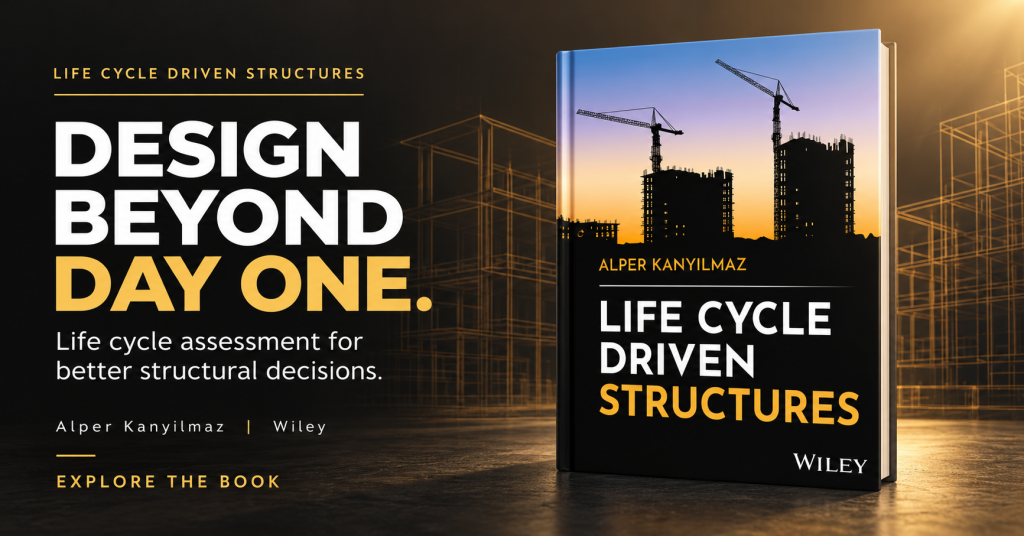
Life Cycle Driven Structures
Alper Kanyilmaz | Wiley
Life Cycle Driven Structures connects structural engineering with environmental assessment, guiding readers from measuring embodied carbon to comparing and optimizing design choices.
Written for students and practitioners, the book combines worked examples, parametric studies and international project experience across steel, reinforced concrete, mass timber and hybrid structural systems.
25 case studies | 15 countries | 6 continents
With a foreword by Alison Kinn Bennett of Building Transparency.
From assessment to optimization
How do choices about materials, spans, structural systems and construction methods affect a structure’s environmental performance?
The book develops a practical approach through three connected stages:
Life cycle assessment (LCA): understand where embodied carbon arises, define appropriate assessment boundaries, and calculate impacts using environmental product declarations and carbon data.
Life cycle parameter analysis (LCPA): investigate how changes in geometry, material properties, structural configuration and sourcing affect the results, from individual beams and columns to complete buildings.
Life cycle optimization (LCO): explore design alternatives and evaluate trade-offs between embodied carbon, cost and spatial requirements using multi-objective methods.
Drawing on carbon factor ranges from over 1,000 published environmental product declarations, the book also examines uncertainty, sensitivity to assumptions and the importance of comparing structural options on a consistent basis.
Bringing resilience into the carbon conversation
A structure’s environmental performance depends on how it performs throughout its service life.
The book examines conventional, damage-controlled and seismically isolated design approaches, considering their implications for initial embodied carbon, future damage and repair. It also addresses retrofitting, adaptability, reuse and post-earthquake assessment, connecting structural resilience with long-term environmental performance.
Learning from projects around the world
The book presents 25 case studies from 15 countries across six continents, showing how life cycle thinking is applied across different structural materials, construction methods, climatic conditions and regulatory settings.
The projects cover offices and corporate headquarters, residential buildings, mixed-use towers, shopping malls, hospitals, sports centres, stadiums, cultural and religious buildings, airports, bridges, viaducts, data centres and temporary construction facilities.
Adaptive reuse and circular construction
The case studies explore the transformation of a shopping mall into an ice centre, the reuse of reinforced concrete cores, the application of reclaimed steel, and the conversion of an incomplete structure into corporate headquarters. Together, they examine how existing structures and materials can become resources for new uses.
Material efficiency and construction technology
Projects examine centrifuged high-strength concrete with recycled aggregates, industrialised hospital construction supported by Building Information Modelling (BIM), embodied carbon reduction through cement replacement, and lightweight tensile structures for a major stadium built on reclaimed industrial land.
Hybrid, composite and modular systems
The book covers vertical extensions using mass timber and off-site fabrication; steel-concrete composite frames supporting architectural ambition; modular mass-timber systems with reinforced concrete cores; modular steel construction for complex geometries; mass-timber buildings incorporating concrete and steel; and temporary steel-CLT offices designed for disassembly and reuse.
These studies demonstrate how material combinations, prefabrication, structural detailing and planning for future use can inform both design and construction.
Regenerative design in challenging ground and seismic conditions
The case studies address geotechnical optimization for a sports centre on Pisa’s challenging soil, structural design on a contaminated site, a regenerative hybrid system in a region of high seismicity, and a modular timber-steel mosque rooted in Anatolian architectural tradition.
They also examine how seismic isolation helped hospitals remain operational during the 2023 Türkiye earthquakes, connecting structural resilience with continuity of use and long-term environmental performance.
Resilient infrastructure
Infrastructure examples include bridge design optioneering with high-strength steel, bridge viaducts in Sardinia, airport design combining optimization with shock transmitters and testing, and the integration of precision and sustainability in arch-bridge erection.
Further studies explore airport reconstruction after an earthquake using hybrid timber-steel construction, and data-centre design for seismic resilience.
Contributions from international practice
The case studies draw on the work and project experience of Martin/Martin, Inc.; Bureau Greisch; Cleveland Steel & Tubes; ATI Project; Redesco Progetti; Buro Happold; Columbia Property Trust; Pell Frischmann; Ergodomus Timber Engineering; Gregull & Spang; Moriyama Teshima Architects; Robert Bird Group; RIOS; ATTEC; Turkish Association for Seismic Isolation; GRID International; Proges Engineering; Cimolai S.p.A.; and Nikken Sekkei.
Through project data, photographs and technical accounts shared by contributors, these studies connect the methods developed throughout the book with practical design and delivery decisions. Documented outcomes include embodied carbon reductions, material savings and reuse rates, linked to life cycle assessment, design optimization and strategies for disassembly and future reuse.
This version covers all 25 case-study topics and all 19 organisations named in the preface. 0.pdf
Built for learning and professional practice
Developed from university teaching, the book builds knowledge progressively through worked examples, review questions and discussion questions.
It is designed for upper-level undergraduate and graduate courses in civil and structural engineering, while also supporting technically focused programmes in architecture, building engineering and construction management.
For practising engineers, architects and sustainability consultants, it provides a reference for integrating life cycle assessment into design work, evaluating alternatives and interpreting environmental data critically.
Additional annexes cover global approaches to embodied carbon regulation and using generative AI alongside the book to extend exercises and explore alternative assumptions.
Foreword by Alison Kinn Bennett
Life Cycle Driven Structures opens with a foreword by Alison Kinn Bennett, Executive Director of Building Transparency, the nonprofit stewarding the Embodied Carbon in Construction Calculator (EC3). Her experience includes 28 years with the U.S. Environmental Protection Agency, where she led federal initiatives on environmentally preferable purchasing, embodied carbon and sustainable buildings.
In her foreword, she explains why access to environmental data must be matched by the expertise to turn it into structural design decisions. She highlights the book’s treatment of embodied carbon as a design parameter, connecting material selection, structural systems and seismic design with resilience, adaptability, repair and reuse.
“Getting from a verified number in an EPD to a structural design decision requires real expertise at every step. That expertise is exactly what this book builds.” Alison Kinn Bennett, from the foreword
Praise for Life Cycle Driven Structures
“The level of detail and overall quality of this book are world-class, making it an essential resource for professionals in the construction industry. The building case studies are exceptionally thorough, offering valuable insight into how projects can be designed and constructed, while clearly illustrating the importance of life cycle driven design approaches.”
Joseph Bonica
Principal Structural Engineer at Robert Bird Group
Sydney, Australia
“This publication makes a valuable contribution to the design and engineering community by capturing the evolving state of practice in life cycle driven structural design across an international range of projects. Of particular focus, it highlights how hybrid structural systems combining timber, steel, and concrete can advance architectural ambition while reducing embodied carbon, helping to chart pathways toward sustainable building practice.”
Carol Phillips
Partner, Moriyama Teshima Architects
Toronto, Canada
“Whole life carbon is reshaping how building structures are designed and delivered. This book offers a practical, real-world approach alongside a thorough grounding in the underlying theory and reasoning, making it an essential tool in delivering low-carbon buildings.”
Tom Carr
Associate Director, Structural Engineer at Buro Happold
London, UK
“This world-class book offers a comprehensive and practice-oriented approach to sustainable structural design, seamlessly integrating low-carbon, resilient, and efficient solutions. Through exceptionally thorough case studies of buildings, bridges, and special structures, it vividly illustrates how thoughtful design can deliver meaningful value across the built environment whilst highlighting the critical importance of life cycle driven design approaches, making it an essential and inspiring resource for every professional in the construction industry.”
José Oliveira Pedro
Associate Professor, Civil Engineering, Instituto Superior Técnico
Senior Engineer, GRID International
Lisbon, Portugal
“Circular economy is so important to achieving our carbon goals to help address the climate emergency, so it is great to see a book that brings the theory together with the practice so well. This book encourages people to go and do what needs to be done.”
Roy Fishwick
Managing Director at Cleveland Steel & Tubes
North Yorkshire, UK
“This book offers thoughtful analysis of diverse material approaches and stands as a testament to how collaboration, innovation, and creative design can drive more regenerative and responsible outcomes. It includes a great collection of projects from around the world, showcasing how whole life cycle thinking can be meaningfully integrated into holistic design.”
Golnaz Ighany
Sustainability Director at RIOS
London, UK
“Defining the role of design and engineering in sustainability and positive climate change action is ever more valuable. It is the structural engineer’s responsibility to design elegant and sustainable structures, and we need ways to measure and compare the parameters for these values (at least conceptually). Thanks to these efforts, we are capable of positively measuring embodied carbon in the construction of buildings. Wonderful to be a part of this state-of-the-art review and to be a case study in the framework.”
Ahmet Topbaş
Director at ATTEC
Istanbul, Türkiye
“By bringing sustainable design principles together with the realities of project delivery, this book provides valuable insight into the challenges of delivering low-carbon, resilient, and efficient structures. The detailed case studies demonstrate how thoughtful design can create meaningful change across the built environment, while offering designers practical examples of how to turn the competing demands of modern projects into added value.”
Ricardo Pimentel
Divisional Director, Buildings at Pell Frischmann
London, UK
“This book presents an invaluable collection of background data, case studies, and practical guidance for designers, demystifying embodied carbon analysis and reduction strategies. The level of detail is unsurpassed among current resources available to designers, making it an essential reference that deserves a place in every architect’s, engineer’s, and contractor’s library.”
Kirby Beegles
Associate, Structural Engineer at Martin/Martin Inc.
Denver, USA
“Structural engineering plays an extremely important role in the carbon outcome of our buildings. This is not simply because the structural components of buildings use large quantities of materials. In fact, the engineers have the ‘computing capacity’ to understand the material and environmental consequences of design proposals brought up by architects and inspire optimization, improvement, or, in some cases, just say ‘no!’ This book will contribute to empower students and engineering practitioners in understanding their role and responsibilities in the battle against embodied carbon emissions.”
Dario Trabucco
Associate Professor, Building technology, Venice IUAV University
Council on Vertical Urbanism (CVU) Research Manager
Venice, Italy
Explore the book
Discover the full contents and available formats on the publisher’s website.
View Life Cycle Driven Structures at Wiley →
View Life Cycle Driven Structures at Amazon →
Wiley | 2026 | Hardcover ISBN: 9781394300525